Sunday, November 15, 2009

Road Trip

On Thursday, November 12th, we took a road trip to the City of Brotherly Love to attend the Philadelphia Craft Show, said to be the best craft show in the United States. At 8 AM sharp, we boarded our Peter Pan bus at Port Authority. With thoughts of Tinker Bell dancing in our heads, we were promptly lulled to sleep by the rhythmic sound of the windshield wipers. (Yes, dear readers, we embarked on our journey in the wake of the remnants of Hurricane Ida.) Undeterred by the weather, we carried on, determined to make the most of our $24 round-trip tickets.

Luckily, the station was only two blocks from the show and the rain temporarily slowed down to a sputter as we made our way to the Convention Center. This year's is the 33rd annual Craft Show sponsored by the Philadelphia Museum of Art. The show itself is a juried exhibition and sale of contemporary crafts by 185 talented artisans, including 26 guest artists from Korea.

[Photos: Jean, above left, and Valerie, below right, sporting new hat boxes.]

Once inside, our plan to methodically work our way up each aisle, starting at the far right perimeter, quickly evaporated as soon as we spied the first booth -- Ignatius hats! (Astute readers will recall that Ignatius was the creator of Valerie's fabulous Guggenheim hat.) Ignatius Creegan and Rod Givens are the extremely creative milliners behind Ignatius Hats.

Needless to say, we spent the entire first hour of the show at just this one booth, trying on an amazing array of (dare we say it?) idiosyncratic headpieces. So much for our resolution to not tarry long at any single booth. While they do produce very beautiful traditional hats in straw and in felt (which appeared to be selling like hot cakes, judging by the large number of women trying them on), we were drawn to their more esoteric straw creations, such as this exotic tall black, curvy number.

To create this effect, they take wheat straw plaits and sew them with a special machine, starting at the top of the crown and continuing in concentric circles to wherever their whimsy takes them. Located in Petersburg, VA, the pair travel to a number of craft shows. Do check out their website at www.ignatiushats.com to see where they'll turn up next. Two additional pale straw hats caught our eye: one that resembles a rumpled pacifier and the other that looks somewhat like an old fashioned juicer.


Obviously, one of the most distinctive features of their hats is their wide variety of shapes and sizes, from tiny sequined ovals to wide brimmed skimmers. They even had fleece "Who" hats for winter.

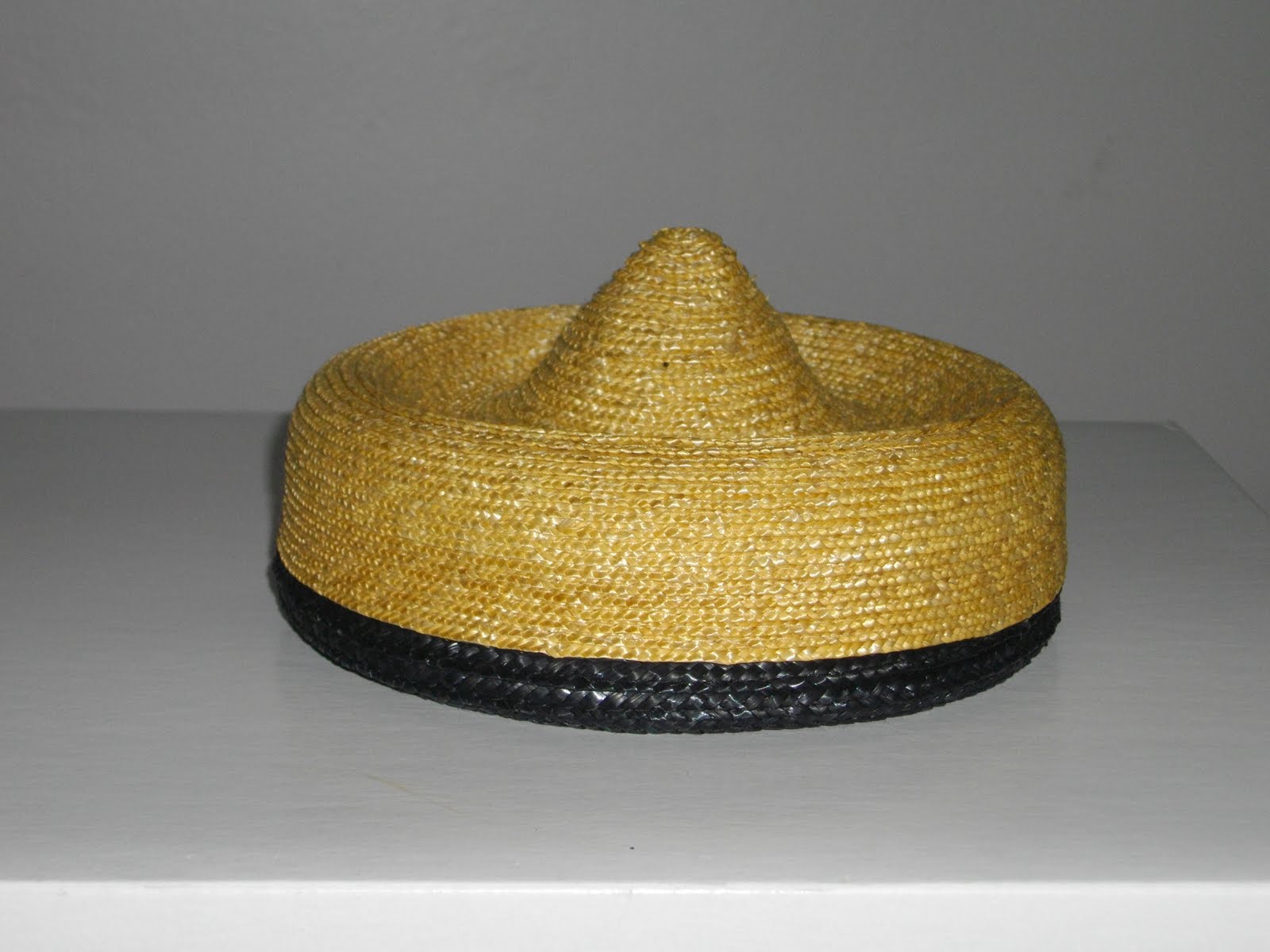
The photograph with all three of the straw hats gives you an idea of the relative differences in scale among the three hats.

Once we'd thoroughly appeased the hat gods, we finally moved on to admire the dizzying array of pottery, metalwork, glassware, textiles and clothing. The attendees of the show really dressed to the nines for the exhibition, so the people-watching only added to the event. The women in particular were extremely well informed about the crafts on display and many accessorized their own outfits with beautifully wrought handmade scarves, shawls and jewelry. After a few hours, when we'd covered about 75% of the space, we took a lunch break to cool our heels and compare notes.

Fortuitously, the famous Reading Market is conveniently located just across the street. The market contains just about any type of prepared food, ranging from Amish Shoo-Fly Pie and sushi to pizza and barbecue. After surveying our many options, we decided on crepes. While each of us enjoyed a variation on a veggie crepe (Jean's had feta cheese), we assessed the show so far. At the conclusion of our scrumptious meal, we were pleasantly surprised when our (French?) chef, who for most of our meal was perfecting that air of condescension required of all French chefs, presented us with a complimentary dessert crepe made with Nutella, fresh bananas and strawberries. Heavenly!

Fortified with food, we returned to the Convention Center to cruise the remaining booths with clear heads and full tummies. As we exited the show, with hat boxes in tow, we headed back home to the Big Apple. We can attest to the fact that the ride was both painless and economical. Since we didn't have to worry about traffic, we could sit back, relax and review the events of the day.

[At left: Jean shakes her booty at the Grayhound terminal. Compare number of bags to earlier photograph.]

Jean is wearing a vintage Stetson bowler hat, Comme des Garcons jacket, skull and star scarf, Michiko Koshino skirt, Dansko clogs and Lounge Fly bag.

Valerie is wearing a gray fulled wool Strawberry hat finished off by a gray and black pin in industrial felt by Danielle Gori-Montanelli (who also had a booth at the show); gray nylon zipper coat by Final Home over a herringbone wool coat by Tamotsu; a Jill Anderson fulled wool sweater with snap front, H&M cotton and lycra camisole, Huge Apple black cotton pants, Reiko Sudo black and white cotton ties around her ankles, and ever-so-comfortable-for-a-full-day-of-walking, if not exactly fashionable, Sebago shoes (apparently meant for yachting, but also great for land-lubbing).

Sunday, November 8, 2009

High Crimes and Misdemeanors


Fashion designers! Do you ever wonder why we don’t wear your product?

Here is our top ten list of fashion NO NO NOs.


Reasons we didn’t buy your otherwise really cool product. These are in order of most obvious and most often to less obvious and less often. So if your particular crime or misdemeanor is at the bottom, that doesn’t mean your offense is any less serious. It’s just not as problematic on a daily basis.

First, the list itself. For the whys behind the list, scroll down.

1. It had your logo on it.
2. It didn’t have pockets.
3. The pattern was only on the front.
4. The seams or hems puckered.
5. The material was inappropriate or poorly made.
6. It had poorly chosen buttons.
7. For shoes: inadvertent puckers and creases.
8. For sneakers:
a) multiple garish colors;
b) design lines implying speed.
9. For coats: no closure.
10. For patterned stockings: not designed to account for leg curves.

Bonus crime/misdemeanor:

11. For socks: too short.


We’re betting most designers already know about all of these problems. They’re thinking these problems are expensive to fix. From our perspective, if we don’t buy the product, doesn’t that make the problems more expensive NOT to fix?

[Technical difficulties: We're slowly adding photos. Please check back in the days to come while we see what we can come up with.]

Here are our reasons:

1. Logos:

If we were both named Carol Channing, we might buy clothing marked with Cs, interlocking or otherwise. But we’re not, so we’re out of luck. The way we were raised, if you advertise someone’s product, you get paid for it. Magazines get paid for it. TV programs get paid for it. And if you say that’s apples and oranges, it’s not. Guys who walk around all day wearing sandwich boards saying “Eat at Joe’s” get paid by Joe for what they wear. Tennis players and race car drivers get paid to wear logos. We pay for clothes we wear because they don’t have logos, and the opposite should also be true: we would be paid if we wore clothes that do have logos. Why should we pay designers to wear their logos? It’s illogical.

We think people who wear logos are making a statement. “I don’t know anything about dressing, but it doesn’t matter. I paid a lot of money for this, and a famous designer made it. As long as you know that, I feel great.”

Our statement is: “We look good in everything we wear. We wear our clothes – our clothes do not wear us. Our clothes advertise us, not our designers.”

2. Pockets: Everything should have pockets. Even a bridal gown, even a night gown. A jacket without pockets might be ok, but pants or a dress or skirt without pockets is for Queen Elizabeth, whose assistants carry everything for her. The rest of us need pockets. We do things and go places. Most of us are not Ann Margret, so we don’t need skin-tight pants without pockets to show off our figures while we do the twist. The police tell us never to carry our keys in our bags. That way we prevent thieves from taking our keys to the address they find in our wallets. The smart thing to do is carry your keys in your right hip pocket and your Metrocard in your left hip pocket (or vice versa). Then if your bag is stolen, you can get home even without your wallet, get into your apartment and console yourself with ice cream before canceling all your credit cards. If you’re a bride, you can carry lipstick or eye drops or a digital camera. If you’re in evening wear, you can carry your cell phone in your pocket so someone can ‘emergency call’ you away if you get bored. Your nightgown? Put a tissue in it, and you won’t have to fumble for the Kleenex box in the middle of the night. What if you fell out of bed? You'd never get back to sleep.

3. Front only patterns*:

We (the Idiosyncratic Fashionistas) buy clothes because they suit our personalities. Our personalities are 360° entities – they do not disappear when we turn around. So it’s disconcerting to try on an item with a great design in the front, and a vast expanse of blank in the back. Dresses, skirts and pants do not really suffer from this, but shirts and sweaters do, and so does lingerie. The design doesn’t have to be the same, but there has to be some continuity beyond the side seams. William van Alen didn’t say ‘Hey, I’ll just design the front of the Chrysler Building – no one’s ever gonna look at the back, anyway.’ He didn’t say ‘Well, gosh, it’ll save Mr. Chrysler a lot of money if I just do the front.’ He designed the whole darned building, and he had FOUR sides to do, not just TWO. So designers, your job is a lot easier. Do it.

In the photo above, a shirt from budget-minded GAP not only has front and back designs, the designer has chevroned the lines in the front - notice how they all match up - AND, as a bonus, made the lines horizontal in the back for more flavor. Notice too that there are no puckers on any of the seams. (See the next NO NO, #4)

In the photo below, William van Alen (center, dressed as the Chrysler Building) shows you how it's done.


4. Puckered seams: Seams and hems should lie smooth and flat. Puckered seams and hems detract and distract from the designer’s purpose.

5. Bad material: Every material, from polyester to silk, comes in a variety of qualities, and part of the designer’s job is to pick the right variety for the right job. Acrylic that stretches too much is not good for sweaters; very thick cotton is good for jackets, but not for shirts. Stiff or shiny material, unless it’s well made, will wear quickly at friction points. Garments that have formed pills before they’ve left the shop will look like little pharmacies by the time they’ve had their first cleaning. Materials have to be chosen carefully (and some materials should probably just get early retirement).

6. Buttons:


It’s difficult (i.e., basically, it ain’t happening) for an Idiosyncratic Fashionista to pay a lot of money for a garment that’s fundamentally wonderful but has awful buttons. Who’s in charge of choosing buttons, anyway? Sometimes it seems it was the pizza delivery guy. It’s possible to replace buttons, but a good button is expensive, and if a garment has, say, 12 buttons, that could easily add up to an extra $50 or more, depending on the button. That’s not counting going to the button store, schlepping the offending garment with you, finding the right button, and then checking to see whether it will go through the button hole. If a garment has bad buttons, a Fashionista REALLY has to love it to invest that much time and money (or she has to buy it second hand). Getting a new set of buttons is the clothing equivalent of taking your kid to the orthodontist.

(And speaking of second hand and buttons, button collectors who collect them at second hand stores, in secret, in dressing rooms, with the help of razors, while they are sewn to garments to which price tags are still attached, are not only violating the letter of the law, they’re violating the spirit of second hand shopping. It is a little known fact that the Salem witch trials of the seventeenth century were really about prosecuting button thieves.)


A Salem woman flaunts her headdress and necklace of ill-gotten vintage buttons as the children look on in opprobrium.


7. Shoe puckers and creases: The horror! The horror! You find what you think is a wonderful shoe, but on closer inspection you can see that the leather is bunched up, and where there should be a smooth surface there is an unsightly leather wart. In purple suede, no less. On a hundred dollar shoe. Or: you buy a perfect shoe, and two weeks later there is a crease on the left big toe, and another crease on the right middle toe. There shouldn’t be creases at all, but if there are, you want them to match. Creases are a sign that the manufacturer built the toe box badly, but it doesn’t matter what it’s a sign of. When you buy a professionally made product you expect a professionally made look. Shoes with creases across the toes look as though they have been stepped on or run over or worn every day in the rain for a month.

8. Sneakers:
a) What is it about sneakers that makes manufacturers think they need to be green and orange and white and pink, all on the same shoe? And that the green has to be leather, the orange has to be suede, the white has to be vinyl, and the pink has to be mesh? With a black rubber sole. Those sneakers go really well with my green leather, orange suede, white vinyl and pink mesh evening gown, particularly when I coordinate everything with my black rubber evening gloves (I wore the whole ensemble several weeks ago to an opening at Lincoln Center), but they’ve been very hard to match with anything else in my wardrobe. And I really do love them because I have foot issues and they’re so comfortable, but I haven’t gotten to the point yet where I feel confident wearing them with my blue business suit.
b) And why do all sneakers have to have speed lines on their sides? I have a size 8.5 foot that I put in a size 9, 9.5 or even 10 shoe. There is nothing fleet about either foot, and putting speed lines on the side isn’t going to fool me into thinking there is. I'm not buying them for speed. I'm buying them for comfort. What about a blue velvet sneaker (for David Lynch fans, or even for people who don’t get this sly reference), or a red suede polka dot sneaker? Now THAT would be rad right about now.

9. Coats with no closures: It’s WINTER, for heaven’s sake! Who wants a coat that doesn’t close? Women with 100 arms can spare two to hold their coats closed. If you only have two, as soon as you have something to carry, your coat leaves you exposed to all the elements. And anyway, don't you get cramps in your joints from gripping your coat so tightly? This is the perfect place for form to follow function.

10. Patterned stockings: We love patterned stockings, and have seen any number of clever designs. The problem is they are made for flat cardboard legs. As soon as a real leg comes anywhere near patterned stockings, the patterns stretch all out of proportion, like images in funhouse mirrors. A Kate Moss type will probably be fine in any patterned tights. For the rest of us, computer design being what it is today, is there no way to make a design that takes into account the contour of a leg? The ancient Greeks employed the concept of entasis in making columns which, though wider in the middle, gave the appearance of being straight. Stocking makers should be able to do the same thing.
In this photo, the striped pattern works, partly because it's strictly horizontal, partly because it's knitted. The polka dots, unfortunately, go from round to oval as they travel up the leg, partly because, well, legs will be legs, and partly because they've been printed on, and do not stretch evenly. You can see a bit of the cracking effect on the more oval dots.

Bonus crime/misdemeanor:

Mind the Gap!

11. Short socks: The Idiosyncratic Fashionistas have, between them, over 100 years of experience in dressing. We’re not crazy about stockings anymore, because they restrict the waistline. But socks are good. LONG socks are good. They look great under pants and (certain) skirts. Short socks, despite their fabulous designs, are prone to exposing that odd, indefinable expanse of skin between where the sock ends and the pants or skirts begin. It’s not erotic, elegant, natural or logical. It’s just an odd space. Long (knee length) socks eliminate that space, and the right sock builds an artful bridge between the shoe and the pants or skirt. We love so many sock patterns, and buy so few of them. All because the designer is only thinking of the pattern, and not the function.

So that’s our list of designer no nos. Anything we forgot? Please feel free to write and remind us!

* Yes, we know there are certain instances where a front only design is entirely OK. We’re not talking about those. One design on the center front of a shirt does not demand another on the center back. But a design all over the front demands a design all over the back.

Sunday, November 1, 2009

A Funny Thing Happened on My Way to ...

Jean says: Invariably, when I am on my way to or from the subway or the bus, I have a strange encounter of the idiosyncratic kind... sometimes solo and sometimes with Valerie, my trusty partner in crime. Following are the results of some of my recent solo forays.* (Click on photos to enlarge.)

One September evening, after alighting from the subway, I walked east, turned the corner at Bleecker onto the Bowery and nearly collided with a beautiful young Asian woman dressed in black rusched tank top, black hot pants (OK, short shorts), with iPod and ear phones -- and black feathered wings! (Please keep in mind, dear reader, that Halloween was still over 7 weeks away at this point in time.) When I asked if I could take her picture, she smiled and said yes, but also added that "I usually like to dance like this," as she climbed up onto a 2 1/2' high parking stanchion and proceeded to groove to whatever was playing on her iPod, facing the Bowery Hotel. She was literally shimmying on a surface smaller than a dessert plate. When I asked her name, she said "Lawn, like the grass." When the song was apparently over and she finished dancing, she hopped down, turned and waved and continued walking north on Bowery. As her pony tail and wings disappeared in the distance into the crowd, I laughed out loud. She was an angel with an edge. I admired her verve, her choreography and her charm. Where else on the planet could such an outfit blend in so effortlessly?

About a week later, while strolling up First Avenue from Houston St., I came upon an amazing car. Every non-windowed or non-mirrored surface was covered with brightly colored plastic toys. Small plastic musical instruments (guitars, keyboards) and telephones mixed with small plastic discs, tiny action figures and 45 rpm vinyl records.


The effect was both startling and amusing, almost cartoonish. The amount of work involved was mind-boggling. The car's owner (visible in the third car photo) was dressed in an equally traffic-stopping outfit, from the Emmett Kelly school of haberdashery. In other words, his attire had a certain circus quality about it. The owner handed out flyers about an upcoming film at the Anthology Film Archives entitled "Automorphosis," in which his fabulous vehicle was featured.


(Apparently, there were more where that one came from.) I was quite moved by the fact that he was so visibly proud of his creation and so willing to share it with the rest of the world. When the movie premiered, many of the crazy automobiles were parked at the curb outside the theater, literally bringing art to the streets.

Who could resist a photo op, against the show-stopping backdrop of this jazzy roadster? As you can see from the photos, the wildly original car is quite a work of art. One can easily imagine Wile E. Coyote at the wheel, careening down the canyons in pursuit of the Road Runner, inevitably crashing the car in dramatic fashion. And if you look closely, you'll also note that I am actually wearing color! (Valerie says: OMG!)


On my way to the subway one morning in September, I ran into Jodi Head on Second Avenue between 4th and 5th Streets. A designer of rock star guitar straps, she is an East Village fixture.


This morning proved to be an extremely rare sighting of Mademoiselle Head without her constant canine companion, RJ Cash, a Yorkie. Needless to say, her little man is spoiled rotten, but, despite all of his royal treatment (outfits, toys, treats, rides in his mistress' bicycle basket, back stage passes to rock concerts), he is amazingly well behaved and people-savvy.

Although she was sans RJ, Jodi was, as ever, sporting tattoos and attitude in equal proportion. Check out those groovy purple-tinted shades that set off the long, feminine hair and masculine boots so well. Although she works harder and longer than just about anyone I know, she always has time for RJ and her 6 felines (yes, 6 cats!). Not the shy wallflower type, she knows how to work her outfits without masking her personality. Her look exudes strength and confidence and self-assurance. The French have a saying for it: "comfortable in your own skin."


One evening in late September, as I was walking to the subway down Fifth Avenue near St. Patrick's, I got sidetracked. (I have a serious case of fashion ADD) and ended up in Diesel. Although I do not own a pair of jeans, I inexplicably took a fancy to a jodhpur-like pair in the window. Once inside the store, however, I was thoroughly distracted by the presence of Dell, my bi-coastal saleswoman extraordinaire.

A strong personality, Dell possesses that lethal combination of a dry wit, quick mind and wicked sense of humor. Her tattoo collection is extensive and eclectic, to say the least. Her asymmetrical hair with bleached highlights and her piercings set off her tattoos quite nicely. Dell exudes a mellow West Coast surfer-chick vibe despite her somewhat "Road Warrior in the urban jungle" East Coast aesthetic. She sports black dog tags with poker chips around her neck. Her under-chin 4-jeweled diamond tat was a first in my book and she indulged me with a close-up shot.

(Oh, yes, about those jodhpur-jeans: I loved, loved, loved how they fit and hated, hated, hated how much they cost. Anything whose cost approaches $400 ought to include round-trip air fare to Europe or something equally fabulous. Any single article of clothing in that price range is an extravagance that neither my conscience nor my budget can justify. Ladies, repeat after me: Women of any age can be stylish without going broke.)

What all of the individuals in these photographs have in common is a strong personal sense of style and of how they wish to present themselves to the world. While such looks are not for the faint of heart, they suit their owners particularly well. This is not a easy task, as evidenced by their many counterparts who are not quite up to the challenge - yet.

In front of the crazy car, Jean is wearing an Issey Miyake Fete long black jacket and pea green skirt, Donna Karan black tunic, Dansko clogs, Lounge Fly bag, red skull ring from American Buffalo in the East Village, Gucci glasses and black Calvin Klein eyeglass chain. In Diesel, she is wearing her vintage black ziggurat hat, charm necklace, Kyodan jacket, Lilith skirt, Ice Pirates watch, Missoni glasses and the ever-present Dansko clogs.

*Because the time and space continuum occasionally prevents simultaneous joint outings by both IFs (Idiosyncratic Fashionistas, of course), we shall from time to time include entries on our solo expeditions. Fans of one or the other of us, please bear with us. In addition, however, it is very interesting to note that while one IF is sometimes intimidating or baffling, two IFs create a critical mass that is somehow much more approachable. While comments from passersby on solo jaunts do occur, they are not presented with the same frequency or urgency or air of shared intimacy as are reactions to our excursions in tandem.

Sunday, October 25, 2009

A Hat of One's Own

Valerie says:

Jean called me one Wednesday night early this year, adamant that I visit one of her favorite thrift shops. Knowing my love of felt, she wanted me to see a felt bag put out for sale with a marvelous “sea creature” on it. I was reluctant. Partly, I thought, what’s wonderful for one person is not always wonderful for another. What if I didn’t like it? I would have made a long trip for nothing, and I would have to sheepishly confess to my very dear friend that it didn’t catch my fancy as it had caught hers. Partly I thought that by the time I got there it would be gone. And finally I thought I didn’t want yet another bag. I must have a dozen lovely bags, most of which I have consigned to the closet. I live now with one of two bags, both black, lightweight, foldable, with a million useful pockets, and compatible with almost everything. Heaven for women who hate always forgetting something in “the other bag”.

She called me Thursday night. Had I seen it? No. She called me Friday night. Had I seen it? No. So, more guilt-ridden than enthusiastic, Saturday I went out to see it, thinking for sure that it would be gone. But how could I not follow my friend’s advice when she was so excited on my behalf?

It took me about 15 minutes to find the bag (although it was exactly where she said it would be). It was black felt, about one foot square, with a felt shoulder strap and a small tuft of deep blue Mongolian lamb's fur at each end of the strap. One side was decorated with the sea creature, which was sewn on with a few stitches. To some extent I was amazed that it was still there, because it truly was fabulous. But then again one could see how it didn’t fit into most consumer categories. It was not a Coach or a Judith Leiber, not Hermes or Chanel or the legendary Birkin bag. And the sea creature Jean referred to was an octopus, so faithfully rendered that although it didn’t have eyes or a beak (because the maker envisioned it from behind???), it did have a very realistic crease in its baggy round head. How many women compete to have an octopus bag? Knowing fully well that this one foot square thing with no pockets would never do as a bag, I nevertheless took it home, intent on doing something with the octopus.

On arriving home, I went through my collection of hats and found one that I had bought disassembled at the now defunct dollar flea market in Chelsea. It consisted of a black felt 1950s juliet cap, and black felt discs with pinked edges, about the size of silver dollars, strung on a long wire covered in the same black felt. I had never managed to put it back together in its original form, and it seemed destined never to be worn.

I got out my sewing box, and cut the octopus away from the bag. Then I put the juliet cap on my head, and juxtaposed the octopus against it this way and that to see whether the combination would work. In less than a minute I had it arranged so that the head looked like a brooch, and its tentacles looked like feathers springing from the brooch. I used a few needles to hold everything in place, took it off my head, and sewed the octopus to the cap with three or four basting stitches. In no more than five minutes the whole operation was complete.

The following day Jean and I had a date to see the Valentina exhibition at The Museum of the City of New York, and I wore the hat there (see the photo below), to show her the results of her sharp eye and astute advice.

A little research revealed that the felt octopus is a stunningly accurate rendition of the blue ringed octopus, a very small and highly venomous denizen of the Pacific Rim, lending new meaning to the expression “killer hat”.

In this photo, Valerie is wearing the octopus hat, multicolored and shibori'd Issey Miyake shirt and pants, spring green Uniqlo stockings cut and worn as sleeves, and apparently no shoes.

Jean is wearing a vintage grey felt "toy" hat from the 1940s, silver Donna Karan silk parachute pants, light grey modal DKNY top, black Calvin Klein T-shirt and "charm" necklace, and also appears to have neglected to wear shoes.

The fabulous photo of the real blue ringed octopus is from www.blueboard.com/mantis.

The octopus hat later appeared in the New York Times Style section.


Do Try This at Home: Other Hat Projects

Because many people have an irrational fear of hats (also known by its improbable taxonomic name, cocklaphobia), we thought we'd show our readers several other hats we created out of this and that, and previous incarnations of other hats.

Here is a hat put together with a black fiber place mat (from gallery gen), a black grosgrain ribbon (from M&J Trimmings on Avenue of the Americas), and a vintage Bakelite or celluloid dog puzzle (from the new DUMBO flea market), seated on a small bit of oak tag for stability, and lashed to the hat in a manner somewhat reminiscent of the way Gulliver was lashed to the ground by the Lilliputians. It took probably 15 minutes to assemble, although it took two years for all the parts to come together.


Here is a detail of the hat showing the dog and the knotted ribbon.

Some might feel reluctant to use tchotchkes as decorations for hats, wanting something more upscale. This hat could just as easily have had real or fake pearls as its centerpiece, a piece of coral, a large vintage button, an upstanding tight spiral of the same grosgrain used for the neckband, or any number of other decorations.

But let's not be too quick to dismiss tchotchkes for hats. There is an old and revered tradition of just that. The milliner best known for the use of tchotchkes was Chicago’s Bes-Ben, during the heyday of hats. In fact, one of the most expensive hats ever sold at auction was a Bes-Ben creation. (See the link above for details.)

This is a vintage brown suede hat from the ‘40s that used to be decorated with a large fiber bird. When the poor bedraggled old bird went the way of all things, it was replaced with three African porcupine quills from the much-missed Craft Caravan, late of Greene Street in Soho. The very sharp points on the quills were easily rounded into submission with an emery board. Holes were punched in the quill tips with standard sewing needles, and the quills were then sewn to the hat.


This is Strawberry's version of the Afghan hat, a shapeless fulled wool tube, usually rolled at the end to form a brim, bringing the crown of the hat very close to the head. By folding the tube once, instead of rolling it, the hat becomes tall and slim instead of low and wide. Added to the hat is a brooch made of alternating black and gray felt squares, layered and cut in ever smaller sizes, to form a pyramid (made by Danielle Gori-Montanelli), adding a bit of flavor, fun and mystery to an otherwise very simple form.

Jean says:

For the Fifth Avenue Easter Parade last April, I improvised by embellishing a black nylon and elastane Titan athletic skull cap from Duane Reade (originally designed for football players to wear under their helmets). After reinforcing a 3" diameter circle with nail polish on the inside (to prevent runs) and allowing it to dry, I cut a hole and inserted a 7" tall metallic green paper vase through the hole, so that the vase would appear to protrude from the top of my skull. The vase's 3 1/2" diameter plastic base was secured in place by the stretchy fabric of the skull cap. From the vase sprouted a fountain of 8" strands of multi-colored colored mylar flowers topped by silver strips, lavender Easter eggs, and pink bunnies.


Paired with a Norma Kamali 80's leopard jacket, the hat beautifully survived numerous wind gusts and post-parade cocktails at the restaurant at MOMA. Total cost (excluding nail polish) was $9.00. Judge the results for yourself here. (Click on photos to enlarge.) For details on Easter outfits and hats worn by Shiho, Valerie and me, please see our blog entry entitled "Stalking the Wild Bill".

Speaking of hats, November 18th marks the St. Catherine's Day Fete of the Milliners Guild. St. Catherine is the patron saint of milliners, and the Milliners Guild will be sponsoring a hat walk which will depart from the Milliners District Synagogue. If you have an interest in hats, this is the ideal place for you to meet like-minded people and see some wonderful creations. For more information, click here.

If you get started now, you can have a hat of your own to wear to the festivities.


Sunday, October 18, 2009

'Tis the Season of the Bat

One of Jean's favorite times of the year is Halloween because skulls, black cats and bats are "a few of her favorite things". (Valerie shares an affinity for the latter two categories.) Before the retail and advertising industries inundate us all with cheesy images of witches, goblins, spiders, pumpkins, and skeletons (and, god forbid, Bernie Madoff masks), we wanted to share with you one of our exotic NYC expeditions that took place before we launched our blog: our Bat Walk in Central Park.On Friday, July 24, we took the Bat Walk with twenty-three other intrepid souls who, for a $25 donation, spent two magical hours in the heart of Central Park at night. Sponsored by the American Museum of Natural History, our tour was led by a scientist (a post-doctoral fellow named Chandra who wore a Batman t-shirt) and a self-confessed "bat geek" (a guy who wore a dinosaur-shaped head lamp on his baseball cap and who described with great delight how he and his wife trap and band bats in South America with a team of scientists). Both proved to possess a wealth of knowledge which they cheerfully shared with our group.

The tour started at 8:30pm on the steps of the museum, under the statue of Teddy Roosevelt. (As an added fashion and sports treat, since the museum was hosting the World Cup Soccer Gala that evening, we made friends with the paparazzi and critiqued the handsome players' outfits and their escorts' gowns. But we digress...)

We were first given an overview of the history and terrain of Central Park (a totally man-made park specifically designed by Frederick Law Olmstead to look "natural") and its flora and fauna. Originally, sheep (hence "Sheep Meadow") inhabited the park, but its current denizens include raccoons, opossums, squirrels, chipmunks, turtles, hawks, egrets, owls and occasional feral cats and insects (something like 20 species of butterflies and 100 species of moths, but don't quote us). There are three species of bats in Central Park: small brown bats, large brown bats and red bats. (Those are both formal names and descriptors.)

At about 8:50 PM, armed with our trusty flashlights and two of the museum's battery-operated bat sensors, our merry little band headed off into the park. Ages ranged from 5 to about 70. (And no, kiddies, we were NOT the oldest. No jokes about old bats out hunting for old bats - or for young bats!) We'd barely entered the park before encountering our first wild animal (hit with the glare of our flashlights at the first rustling): a large, lazy raccoon rummaging for a snack. As we had bigger fish to fry, we soon moved on. We sat on a rock at the edge of Central Park Lake for about 45 minutes and, in between a question and answer session, tried to listen to the bat sensors click in response to bats' ultra-high frequency calls. (Note to the file: Next time, dress more sensibly and bring something soft to sit on!)

The good news was that the evening was cool and not humid (optimum from the human comfort standpoint). The bad news was that bats greatly prefer hot, muggy, buggy nights (optimum conditions for bat sightings and hearings). None of us saw any bats silhouetted against the sky, despite our best efforts, although our host and hostess said faint clicks on the sensors indicated two or three fleeting bat cameo appearances. We were, however, treated to the dramatic arrival of a black-crowned night heron which swooped past us, barely clearing the surface of the lake. (Who knew such large birds were nocturnal?) With a 48" wing span, it was positively majestic. Since our Bat Walk turned out to be a Bat-less Walk, the great bird's arrival was the perfect ending to a wonderfully entertaining evening. Needless to say, we thoroughly enjoyed ourselves and were elated as we exited the park with our compatriots of the evening.

Valerie is wearing a cap of white perforated leather by Antoinette, gray nylon vest by Final Home, printed tee shirt by H&M, vintage Issey Miyake leather, metal and elastic belt, cotton and acrylic resin pants with drawstring knees by Oska, and her perennial favorite comfortable shoes - nubuck flats by Arche.

Jean is wearing a DKNY knit jacket, Calvin Klein t-shirt, Urban Outfitters harem pants, Titan nylon skull cap with Art Deco Bakelite domino pin, Ice Pirates watch, charm necklace (with idiosyncratic charms of her choice), white Bakelite chain necklace (from the Brooklyn Bridge flea market), Lounge Fly bag and Gucci glasses.

On a more serious note, our host and hostess suggested that one of the reasons they did not get the number of bat sightings they expected might have to do with white nose syndrome, a fungus which has wiped out whole colonies of northeast bat population who hibernate in caves. As bats play a major role in controlling insect populations, their loss is very threatening to the balance of nature. Scientists have not yet learned the source of white nose syndrome, or how to combat it. Anyone interested in finding out more, or making a donation, is encouraged to visit the Bat Conservation International website.

Sunday, October 11, 2009

From the Ridiculous to the Sublime


In 2003, when Elizabeth Gibson unwittingly rescued Rufino Tamayo's Three People (Tres Personajes) at a curbside where it was waiting to be hauled away by the Sanitation Department, she gave new cachet to the pastime of dumpster diving. Almost two years ago, the Tamayo was auctioned at Sotheby's for just over $1 million, and Gibson received a nice finder's fee.


So on our way to The Japan Society for the opening of the Serizawa exhibition, we were not above stopping in front of an array of garbage probably 25 feet long to inspect a 34" x 50" framed cotton textile with psychedelic '70s characteristics carelessly placed on a discarded sofa that had clearly seen better days. Jean guessed, with admirable accuracy, that it was a Marimekko. Printing on the selvedge identified it as "Eve" by Katsuji Wakisaka, from 1972. In a moment, like car thieves, we were working - in all our finery - to strip the print from its frame so we could pocket it and get to the opening. But the framer had stapled the textile professionally, and as we had both neglected to bring our staple removers with us, we were forced to make a decision. We took the Marimekko home in its frame, making us late to the opening. (Well, what would YOU have done?!) While not exactly a million dollar lost Tamayo, it was nevertheless a small and enjoyable coup.

From the small Marimekko Outdoor Art Fair we proceeded to the rather more lavish show at The Japan Society. We went to the Serizawa exhibition primarily to have a look at his wonderfully idiosyncratic kimonos which, given their large size, allowed Serizawa to make some very bold and original statements. Keisuke Serizawa (1895 - 1984), designated a Living National Treasure by the Japanese government, was beloved in Japan for his lyrical color combinations and immediately identifiable woodcut-like designs. Check out the link above to see some of the wonderful pieces selected for the show. Here we are with Roxane Witke, a fellow admirer of all things Japanese.

Reluctantly, we rushed through the exhibition, because on this particular night we were faced with the singular pleasure and dilemma of two shows to see on the same night. (By a stroke of luck, we had separate benefactors who invited us to the same Whitney reception and guided tour.) So off we rushed to the Whitney for a small evening tour of the new "Georgia O'Keeffe: Abstraction" exhibition.

We flagged down a sweet young taxi driver who peppered us effusively with questions ("Where are you two going dressed like that?" "Do you always wear such hats?") and compliments ("You both look great"), leaving us in great spirits as we alighted, and ready for the next part of our adventure.

Our readers might remember that we were recently able to take photographs of ourselves inside the Guggenheim Museum. Having been raised in the '50s, when the zeitgeist turned away from the fast-talking women of the '30s and the capable, sacrificing women of the '40s, and morphed into the culture of that miserable Good Girl Who Values Her Reputation Above All Else, we are still trying to shake off the last vestiges of that deeply ingrained early training. Sometimes that means daring acts of slightly uncivil disobedience, like taking surreptitious photographs in museums. Our small group of about 15 people was followed everywhere by a guard (since the very informative and thoughtful tour was conducted after hours), so we took very few photographs. Just small gestures, really -- mostly to prove to ourselves that we are indeed Very Bad Girls. Below you can see Jean, apparently following the talk yet standing just slightly apart from the crowd, while Valerie, ostensibly resting her feet (why isn't there a bench in every room?), takes the forbidden picture.

We had more than enough time to see everything at the Whitney, and the paintings showed a side of O'Keeffe that is less known than -- but every bit as interesting as -- the O'Keeffe of gigantic sensuous flowers and stark bleached skulls. It didn't hurt to hear our guide tell a few Bad Girl tales about O'Keeffe, either.

After the tour, we looked for a small cafe in the neighborhood where we could have a wee post-lecture drinkie. At the first place we tried, which had two tiny tables free in its charming picture window, we were only invited to sit in what were clearly its "B List" seats. The waiter insisted that even after 9pm the petite tables at the window were reserved for patrons ordering dinners, not wee drinkies. This was puzzling because the tables were barely big enough to fit our elbows, much less dinner plates, but never mind. Off we went to the welcoming arms of Lumi's, just a few blocks south.

Lumi's is a cozy Italian bistro that one steps down into, giving a fresh perspective on passersby as one gazes out the windows, and the sprial staircase in the center of the front room also delights the eye. The staff invited us to sit wherever we liked, so we chose to sit in the back, warming ourselves after the chilly evening walk and the chillier reception at the previous restaurant (which we shall not name).

After ordering champagne cocktails, we realized that we were being photographed by a gentleman at the table next to us. He introduced himself as Fadil, and said he was a professional photographer. When he told us that he and the party at his table (including Lumi, the welcoming young owner, and Patrick, her gallant husband) had been talking about us and LOVED our style and our hats, we were hooked. (How easy it is to flatter us.) But when Fadil further stated that he was meeting the peerless Carmen dell'Orefice there for dinner, and that he would introduce us when she arrived, we were floored. Carmen is a role model for all women of a certain age, and all women who will one day become women of a certain age. She was the subject of Fadil's Rolex ad campaign geared to our demographic of choice.

Although mourning the loss of her dear friend Irving Penn (whose obituary was The New York Times' front page news that morning), Carmen arrived looking flawlessly beautiful, and Fadil, true to his word, kindly introduced us (and took the photo above). We mentioned having seen Carmen's '50s fashion shots at the International Center of Photography's "AVEDON FASHION" show (May-Sept 2009). Carmen was as warm and gracious as she was stunning. When we told her we'd admired her pictures at the Metropolitan's "Model as Muse" show in the Costume Institute, Carmen conspiratorially shared that she'd had to stand in heels for hours at the exhibit's opening night, striking a cord with us! To further underscore her point, she then drew one of her feet out from under the table to reveal that she was wearing flats. A fellow traveler on the flat road! By way of contrast, Lumi then showed off her black Alexander McQeeen studded stilettos to our oohs and aaahs. As their entrees arrived, we bid the merry quartet adieu and headed off into the night.

After that serendipitous encounter, our high spririts could not be daunted even by the vagaries of the New York City subway system. Despite the fact that the entire floor of our subway car was sticky with spilled Dunkin' Donuts flavored coffee, and the aroma of hazelnut wafted through the air, we were positively giddy as we reflected on the events of the evening. Our good humor and high style were memorialized by a fellow traveler in a photo finish.

Jean is wearing a black feathered '40s vintage hat (purchased at last spring's Metropolitan Pavilion Vintage Show), black Comme des Garcons wool jacket (with shoulders like a linebacker), black Michiko Koshino skirt, painted wood folk art rosary necklace from New Mexico, black Linda Leal long sleeve T-shirt, Dansko clogs, Gucci glasses and Lounge Fly bag.

Valerie wears a pink spiral velvet vintage Bonwit Teller hat, black silk Elizabeth Arden coat, black and gray shibori'd Gianni Versace jacket over a black Ivan Grundahl dress, James Minson glass necklace and black Aerosole flats.

Saturday, October 3, 2009

Isabel Toledo

On 9/26, we ran to W. 27th Street & 7th Avenue to catch FIT's Isabel Toledo show ("Fashion from the Inside Out") around 4pm on its closing day (Procrastinating Fashionistas, anyone?). Better late than never, we quickly joined the crowds admiring her colorful geometric designs.


The show was masterfully curated by Dr. Valerie Steele, Director, and Patricia Mears, Deputy Director of the Museum at FIT. Our vintage hats off, ladies!


Isabel Toledo's mid-career retrospective was divided into themes based on categories of clothing construction (.e.g., Origami, Suspension, Liquid Architecture). The Cuban-born designer's dresses, jackets, skirts and tops were artfully displayed on playful faceless mannequins. Fabulous whimsical sketches by her husband, Ruben Toledo, appeared high atop the displays on a seemingly endless roll of white butcher paper. His illustrations encircled the entire main room, as if wrapping Isabel's show in a warm hug. We felt as if the show catalogued decades of their creative collaboration.

Isabel's Origami designs consist of geometric shapes folded into three dimensional sculptural garments. Jean's personal favorite was the black armadillo-sleeved shirtwaist dress from Fall/Winter 2008. (Sometimes when we go on these excursions we are allowed to pick one item for ourselves, always an interesting challenge, especially when we are faced with an embarrassement of riches.


Valerie wanted the red jacket with the tiny waist [the remembrance of things past] and overstuffed peplum [the disguise of things present].) Karlo got it "spot on" in his assessment of Isabel and Ruben Toledo as the "it" couple ("Talent, passion, style, vision, culture ... Woof.") in his COMA blog on Isabel at Barney's on Fashion's Night Out.


After exiting the Toledo show, we met Maureen, a wonderfully beautiful octogenarian, who chatted and posed for pictures with us in the lobby. Among other tidbits, she mentioned with great pride that both she and her parents had been born in the Village. She had a short shock of gorgeous stark white hair under that hat. Before bidding a fond farewell, she did invite us for "tea ... or cocktails." Smart cookie!


Jean is wearing a vintage hat (originally from The Blum Store in Philadelphia) atop an aubergine Emporio Armani peplum jacket, black Michiko Koshino skirt, Comme des Garcons T-shirt, Dansko clogs and Lounge Fly bag.

Valerie is wearing an asymmetrical vintage black curly lamb and purple velvet military cap from Bonwit Teller (like Jean's hat, also from the city that brought us both Grace Kelly and the highly idiosyncratic Dr. Barnes of the eponymous Collection), a black and purple cotton and rayon polka dot jacket by Perry Ellis, a creature brooch in beads and layered yellow and purple felt by Lynn McClain, purple cotton camisole by H&M, purple cotton and polyester harem pants by Issey Miyake and cornflower Mary Jane shoes by Land's End.
We were ever so strictly forbidden to take pictures inside the exhibition, so we took pictures of ourselves instead!